|
Modeling of porosity in sintered disperse powders
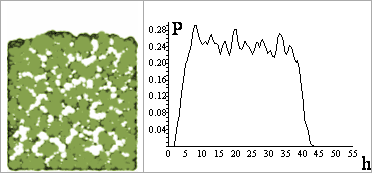
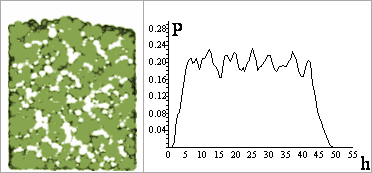
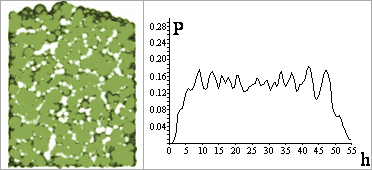
S3D Evolution allows performance of computational experiments that demonstrate correlation relationship among the dispersion characteristics of the powders,
consolidation speed and porosity. Computational experiments demonstrate the way the disperse characteristics of the particles affect porosity characteristics. S3D
Evolution models the conditions under which the sintering causes genesis of either large intergroup pores, or pores within the groups. The latter pores are uniformly
distributed by volume.
 |
| a |
 |
| b |
 |
| c |
| Fig. 1. Microstructure and distribution of porosity P by height h in the model packing of disperse particles. Sintering is modeled with the
diffusion-viscous flow mechanism: (a) monodisperse system, R=1; (b) system with normal distribution of particles size, R=1, σ=0,2; (c) system with
log-normal distribution of particles size, R=1, lnσ=0,3 |
|
|
|
|
| S3D Evolution Solutions |
|
|
 |
|