|
Modeling zonal segregation during the disperse powders sintering
S3D Evolution is used to perform computational experiments in order to research topological transformations occurring in disperser powder body during the free
sintering. Disperse particles sintering models (diffusion-viscous flow mechanisms) demonstrate that the process of group particles movement in the disperse powder
body may cause formation of separate particle groups. Contraction and consolidation occur within these groups.
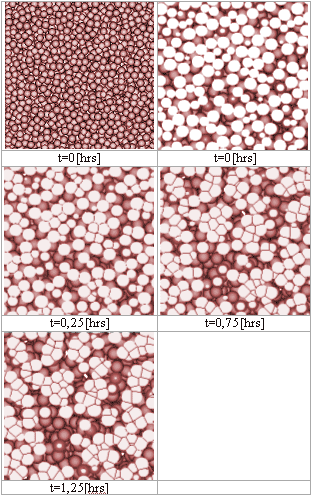 |
| Fig. 1. Model of structure evolution during the sintering the non-regular disperse particles. Sintering mechanism is the diffusion-viscous
flow. t = 1,0 [hrs] corresponds with 1 hour duration of practical sintering |
|
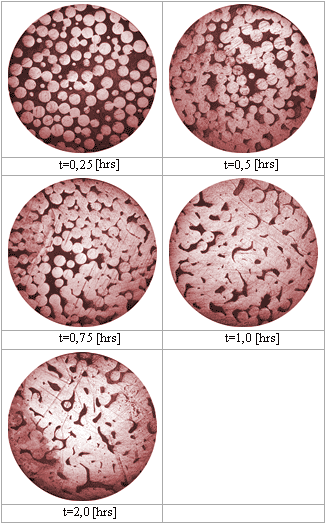 |
| Fig. 2. Fragments of structure evolution for the non-pressed spherical particles (bottle glass) during the solid-phase sintering. Average
particle size R=1mm, T=750В°C |
|
|
|
|
| S3D Evolution Solutions |
|
|
 |
|