|
Methods and Algorithms. Model of Sintering Spherical
Particles
The close packing of spheres represents the initial data for
the simulation of the evolution of the spheres during sintering.
For deriving the equations of movement and dynamics of the sizes
of the sintered, the main incentive was to satisfy the equations
of kinetics of pair sintering for each pair of contacted spheres
in the system.
Let us consider sintering of a system consisting of N spheres:
Si (Ri, ri, vi), i = l, 2, …, N; Ri — radii of the spheres, ri
— coordinates of their centers, vi — speed of movement. To
describe the free movement of the spheres, the well-known
equations of Newton are used:
 (1) (1)
Here mi — density of the material of the spheres, Fi — sum
of external forces, acting on each sphere, such as the force of
gravity or force of liquid friction ( – wi|S|i, |S|i
— area of free surface of i-th sphere).
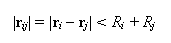
At existence or occurrence of contact:
 (2) (2)
needs to take into account the interaction of the
contacted spheres, resulting in sintering. Let us record the
equations of the kinetics of pair sintering for all pairs of
incident (contacting) spheres in the following form:
 (3) (3)
here and below j --> i means that the spheres i and j are
contacted . And let us construct the deviation functional:
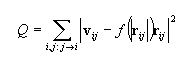 (4) (4)
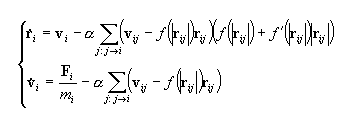
Let us to modify the trajectory of movement of corresponding
point for an ensemble of spheres in the phase space so that it
come nearer to a minimum of the deviation functional Q. To do it,
let us to add the antigradient Q with a weight multiplier a
in the right part of the equations (1), where the multiplier a
actually answering for the degree of influence of sintering on
movement of the system of spheres (or vice versa):
 (5) (5)
The conservation of weight means that during movement and
sintering the volume V of the geometrical union of spheres remains
constant:
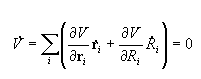 (6) (6)
Let us to balance the change in volume V of the union of
spheres connected with movements of some sphere Si with the change
in the radius Ri of this sphere:
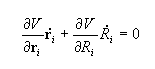 (7) (7)
for each i.
The integration of systems of equations (5) - (7) is proceeded
by the Euler method with fixed time step (Hockney, Eastwood,
1981).
|